
Knowing When To Stop - inside an ultramarathon DNF
A Lilla Horváth story.
Ultrabalaton had been on my bucket list for years, not just because it’s one of the biggest ultras in Hungary, but because Lake Balaton feels deeply personal to me. I spent childhood summers there, and the roads around the lake carry memories of holidays, family, sunshine, freedom, and that strange nostalgia only certain places can give you. So after finishing the South Downs Way 100, signing up for a 209-kilometre lap around Balaton somehow felt like the obvious next step. Completely ridiculous, but obvious. The distance itself wasn’t even the biggest attraction. It was the atmosphere of the race, the incredible organisation, the idea of running around an entire lake in my home country, the vineyards, the scenery, and the familiarity of home. And of course, the challenge. Before the race, finishing meant everything to me. Not just because of the distance, but because it felt like proof that I was progressing as a runner, proof that I could achieve whatever I set my mind to. My dream was to finish under 24 hours. My realistic goal was under 26. The official cut-off was 31 hours, but in my head I barely acknowledged that number existed. I never imagined not finishing. That has always been my mentality going into races. I picture myself crossing the line strong, smiling, somehow still looking fabulous despite running for an entire day. I think visualising success before an ultra matters. I never create scenarios where I fail. If things get dark during a race — and ultras always get dark — I deal with it then. And I knew there would be dark moments. I knew I would hit rock bottom at some point, cry, suffer, question my life choices, and bargain with myself in increasingly ridiculous ways. But I also believed I would get through it.
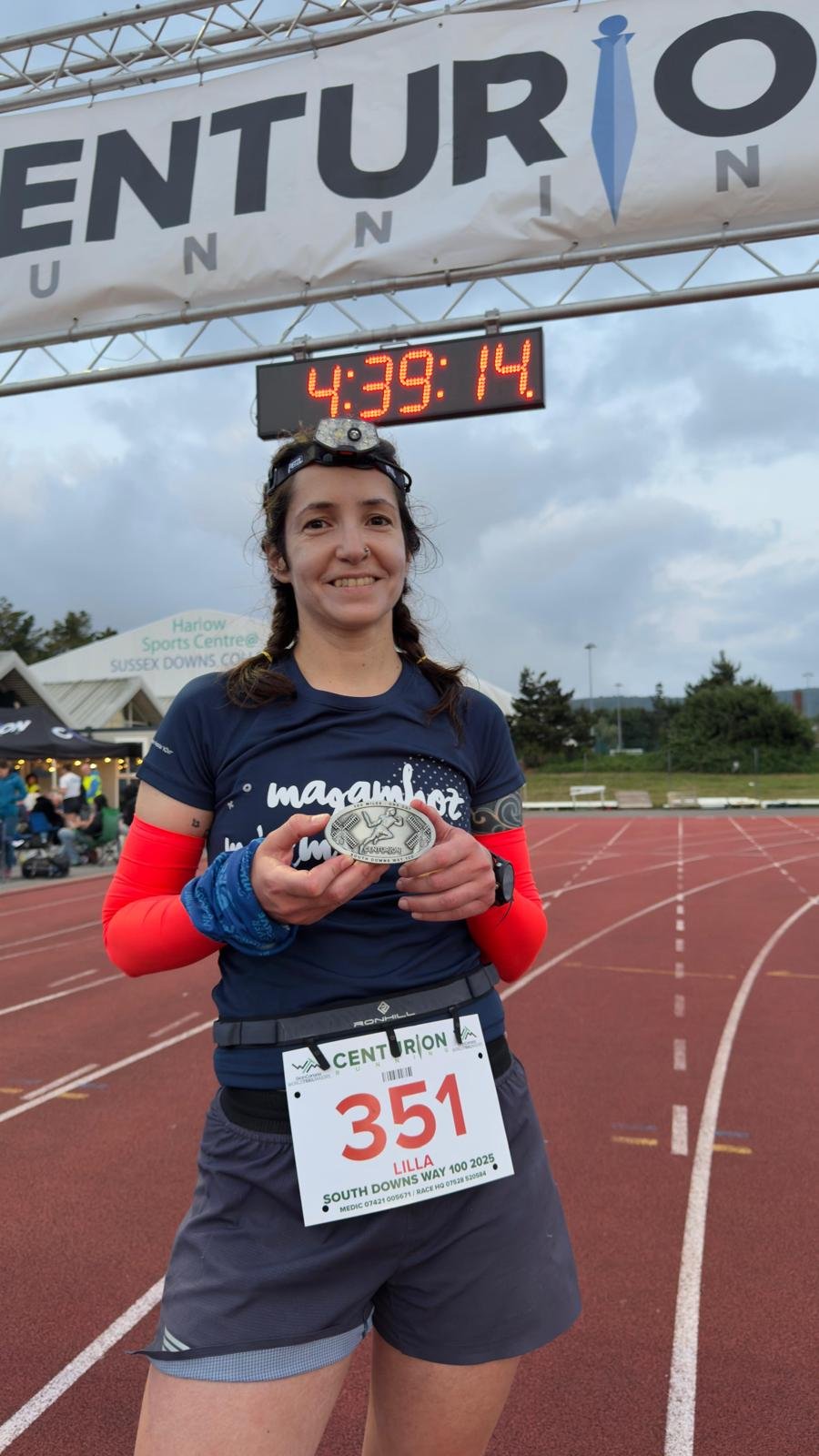
Centurion - South Downs Way 100m finish
That belief came from months of relentless training. The first part focused on speed and strength: hill sessions, speed work, long runs. Then came the stamina phase, where the goal was learning to hold a steady pace for hours on flat roads. The final phase was all about time on feet: back-to-back long efforts, aggressive mileage build-up, and endless fuelling practice. Because one thing people underestimate about ultras is that your stomach needs training just as much as your legs. Every session became an opportunity to practise eating — gels, carbs, electrolytes, more gels, more carbs, over and over again. The race itself was mostly flat, with only around 800 metres of elevation gain, so physically the terrain wasn’t my biggest concern. What worried me more was the sheer amount of time spent running on roads. And despite all the training, I never truly felt ready. I’m one of those runners who constantly feels like they haven’t done enough, even when objectively they probably have. Still, there were moments when things started to click. One session in particular stands out: five hours running in the morning, a four-hour break, then another long evening run in strong winds. My stomach already felt rough before I started, but I fuelled properly, held steady pace, and finished both runs feeling strong. That session gave me confidence. So did working with a coach. Honestly, getting a coach changed everything for me, not just physically but mentally. He helped me become more mindful about how my body was feeling instead of bulldozing through everything. He helped me think long-term instead of only thinking about finishing the current session or race. That mindset would become incredibly important later.
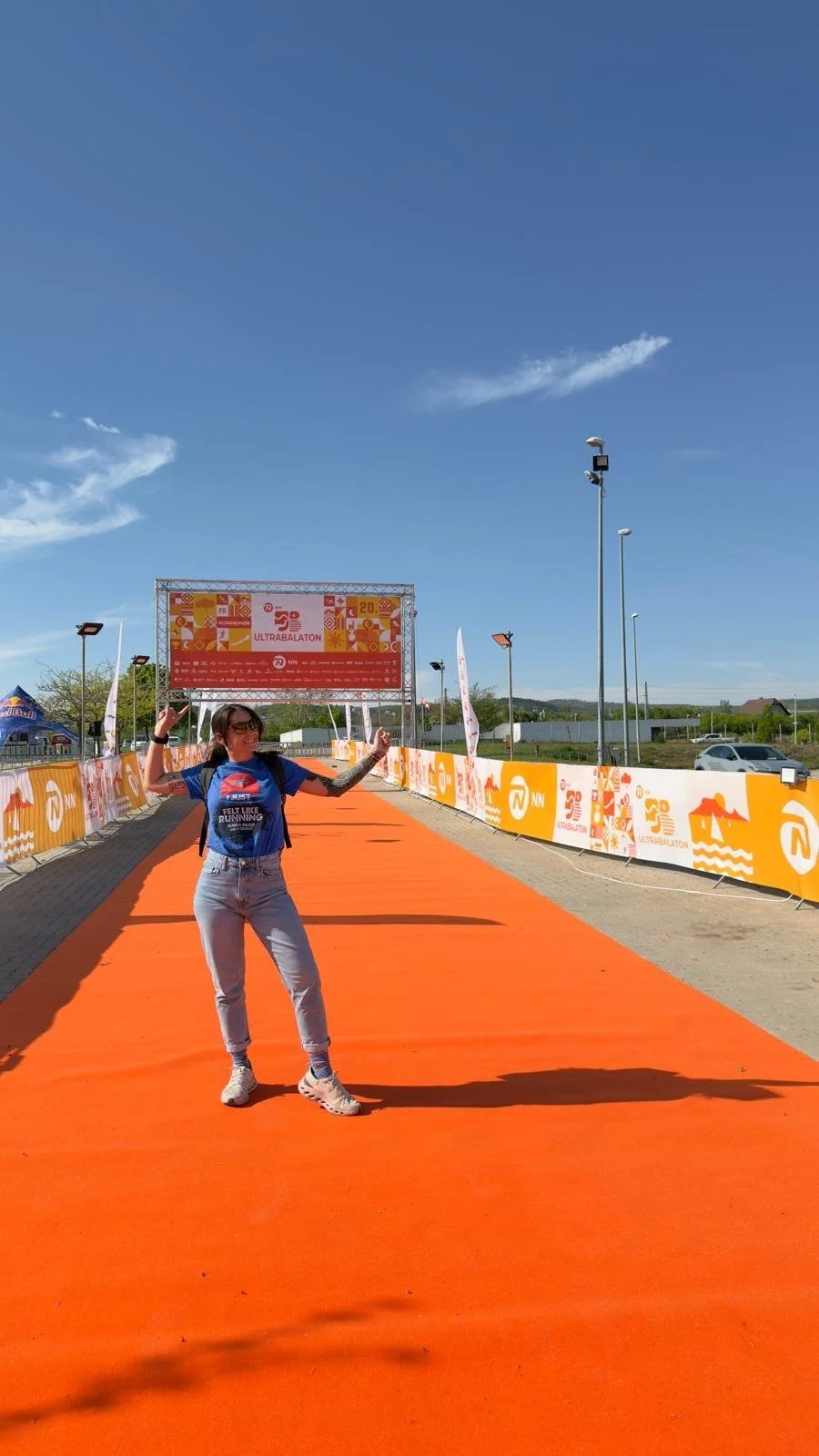
There were warning signs before the race, of course. There always are. Towards the end of training my knees started hurting, which isn’t exactly ideal before a 209-kilometre road ultra. I also lost six weeks of consistency over winter because of endless colds that seemed to circulate forever. Then came race week, and emotionally I was a complete wreck. I had never put so much pressure on myself before a race. I cried multiple times during the race briefing and opening ceremony. I fell down the stairs at the accommodation and hurt my foot. The next day I tripped again and landed on my knee. I forgot important race items at home. I wasn’t eating properly. I wasn’t sleeping properly. It was far from ideal. But then came the countdown. Ultrabalaton has this incredibly emotional race send-off. Before the start, the organisers play the same powerful piece of music every year and give a speech about the journey it took to get there. It’s impossible not to feel emotional. I remember standing there with tears in my eyes when I locked eyes with one of my running heroes, Krisztian “Csipi” Takacs. If you know Hungarian ultrarunning, you know who he is. He’s famous for coming up with increasingly ridiculous endurance challenges, including running two full laps around Lake Balaton — over 420 kilometres — while fundraising for charity. The calm confidence in his expression grounded me instantly. It felt like his eyes were saying: you’ve got this. And for a while, I did.
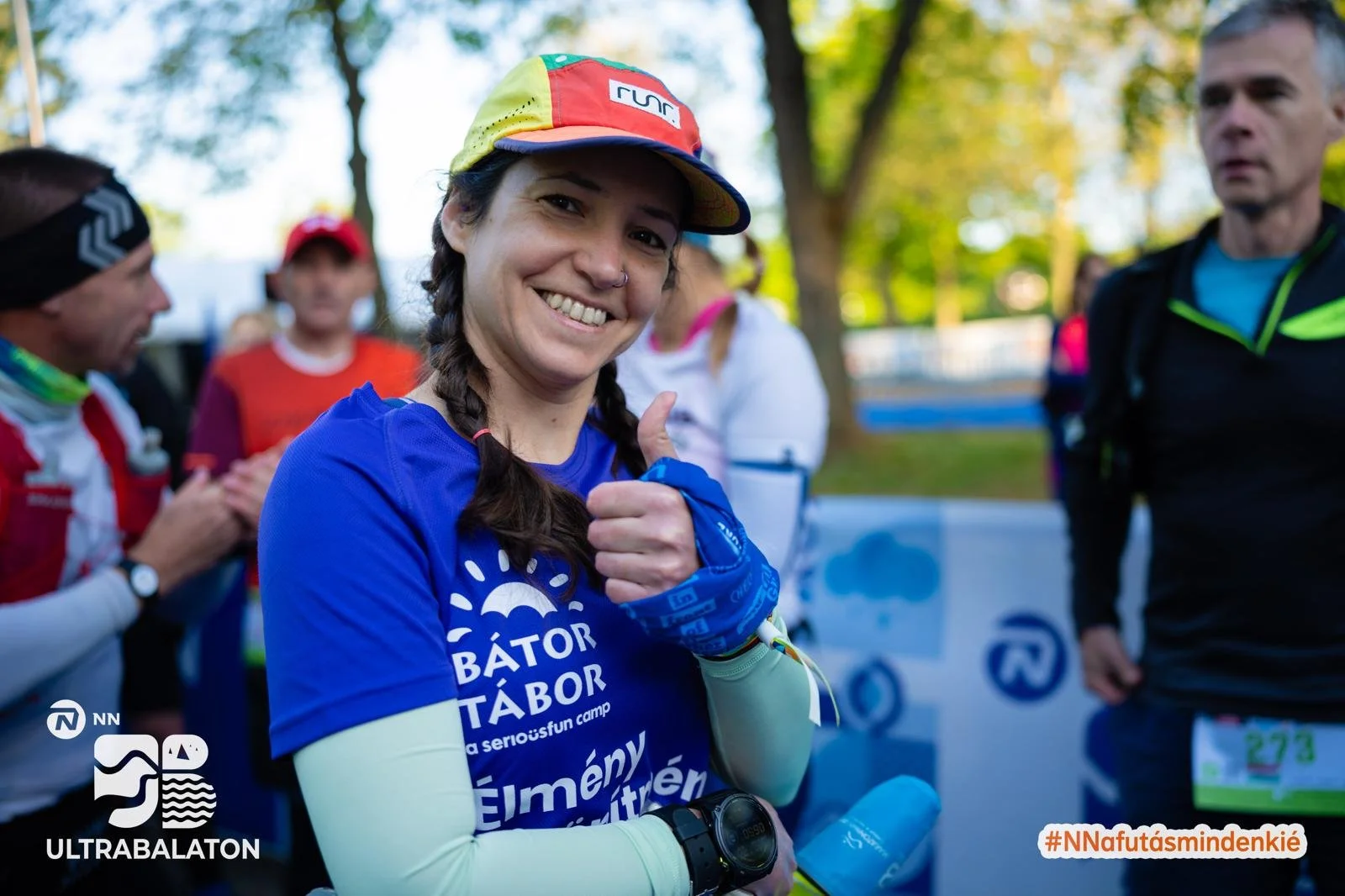
The race started exactly according to plan: slow and steady. Gel every 30 minutes. Solid food every hour. Salt tablets. Constant hydration. Cooling down whenever possible. Everything was going smoothly until around 60 kilometres in, when I started feeling ill. At first I wasn’t too worried. Stomach problems are common in ultras, and usually I can manage them. I switched away from gels and moved onto my emergency fuelling plan: Coke, pretzels, biscuits, nuts, and my ultimate ultra fuel — custard. But then things escalated. At one point I was sick in a bush and my nose started bleeding. Annoyingly, this was also the exact moment Adam — another runner fundraising for the same charity and attempting the insane double-lap challenge — caught up with me looking fresh and cheerful. We exchanged a bit of banter while I tried to locate what I considered an acceptable vomiting spot. Ultra running really is glamorous. Luckily the next checkpoint wasn’t far away, where my parents were waiting with supplies. I called my coach for advice. Deep down, I think part of me wanted him to tell me to stop. But I kept going.
The problem was that this wasn’t improving. Hour after hour passed and I still couldn’t eat properly. The heat became relentless and the sun felt brutal. Physically, my legs were still moving well, but internally something was deteriorating. I started doing constant runners’ maths in my head: calculating pace, cut-offs, whether finishing under 24 hours was gone, then whether 26 hours was gone, then whether finishing at all was becoming unrealistic. When I realised I was covering only around five kilometres an hour, the real questions started. Can I actually finish this? Can I fuel enough to survive another hundred kilometres? Can I keep going without genuinely risking my health? Those questions got louder and louder. By around 80 to 85 kilometres, the emotional breakdowns started. Rich, who was following me on a bike, did everything possible to pull me out of the dark place I was sliding into. At one point he even put Nicky on the phone to encourage me. And it worked, temporarily. I managed another 12 kilometres. I kept hoping the cooler evening air would turn things around. Physically, it helped a little, but by then it was too late. The problem wasn’t just discomfort anymore. I was in a serious energy deficit and still facing more than 100 kilometres of running.
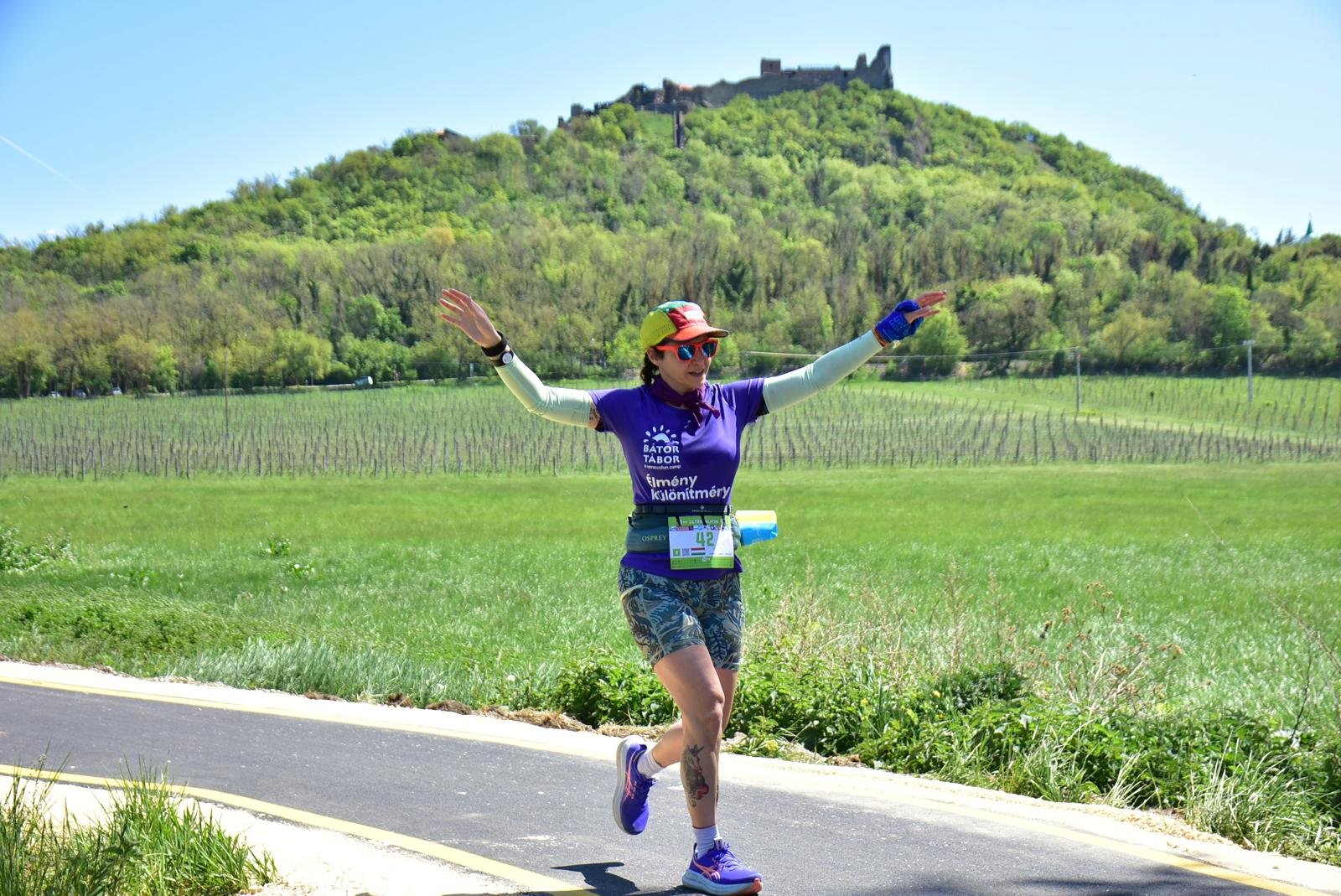
That reality finally caught up with me. For years, my attitude towards ultras had been simple: never quit. As long as I could still move forward, I would continue. DNF felt incompatible with how I saw myself — tough, stubborn, hard as rock, the kind of person who always gets to the finish line. But working with a coach had slowly changed my thinking. He taught me to think long-term, to understand the difference between toughness and recklessness. So when we reached the checkpoint around 102 kilometres, Rich and I sat down and talked honestly. I listed everything working against me: I couldn’t eat, I couldn’t drink enough, I was running out of energy, there was still an enormous distance left, and time was disappearing fast. The only things still working in my favour were my legs and my determination. And determination alone is not enough — not if continuing means risking real damage. That was the hardest part. I still wanted to finish. I was still determined. But not at all costs. Eventually, I made the decision myself. I didn’t want somebody else — medics, cut-offs, complete physical collapse — making it for me. After we decided to stop, I still ran the next section to finish on a better note and reach the halfway checkpoint. Strangely, those final kilometres felt light. Free. Like the pressure had finally disappeared. Then I handed back my timing chip, and it broke me.
I felt devastated. I felt like I had failed everything: the race, the training, my coach, my crew, everyone who supported me. But underneath all that disappointment was relief. Relief that it was finally over. Back at the accommodation, we drove along the route I would still have had to run, and seeing the remaining distance from a car was strangely validating. It was simply too much for the condition I was in. The next morning, after barely sleeping, I went back to the finish line to cheer runners in. It was painful to watch, but also inspiring. Even immediately afterwards, people were incredibly supportive, and slowly, over the following days, my perspective began to change. Because the truth is: I no longer see the race as a failure. If anything, it taught me more than a successful finish might have. It taught me that I finally have a healthy relationship with running, that my identity as a runner is no longer fuelled entirely by ego, that there’s strength in self-awareness, and that sometimes the strongest decision is stopping before you destroy yourself.
For a long time, I thought DNFs only happened when catastrophe struck or when runners were weak or unprepared. Social media certainly doesn’t help. All you see are finish-line photos, medals, and success stories. Finishers are celebrated as heroes — rightly so — while DNFs are often treated like something shameful. But what social media rarely shows is the work behind the start line: the 6 a.m. training runs before work, the exhaustion, the doubt, the early mornings, the endless sessions when motivation disappears and discipline is the only thing carrying you forward. Those things matter too. And now, when I think about Ultrabalaton, I don’t think about failure. I think about growth. About learning the difference between toughness and recklessness. About becoming a stronger, smarter runner. Despite the DNF, I’m proud — proud that I committed fully to the training, proud that I kept going for over 105 kilometres while feeling awful, proud that I had the awareness to stop before things became dangerous. Most of all, I’m proud that I tried. Because ultras are unpredictable. Sometimes you can do everything right and still not get the ending you imagined. And strangely, this race left me feeling more confident and more at peace with myself than ever before. Of course I’m going back. I want my medal. I want my finisher T-shirt. But more than that, I want to stand on that start line again, hear the music, watch the sunset over the lake, and see how the story ends next time.